
Chelsea Flower Show 2026: Selecting Stone, Crafting the Foundations of Our Garden
With just over 3 weeks to go until the Chelsea Flower Show 2026, preparations are well underway. We thought this was a great moment to share another glimpse into the behind-the-scenes work shaping the hard materials for our show garden.
Rob Hardy & Co is an award-winning garden design studio in Leeds, creating bespoke outdoor spaces across Yorkshire and beyond. If you’re planning your own project, explore our garden design services in Leeds and Harrogate, browse our recent garden design projects, or read more articles from our Yorkshire garden design blog for inspiration.
A Day at Allgreen
There are moments within the making of a Chelsea garden that feel quietly pivotal. Not the headline milestones, nor the visible structure taking shape on site, but the slower, more considered days where materials are chosen with care and intent. Tuesday was one of those days.
I spent it at Allgreen in Yeovil, walking their yards, revisiting earlier decisions, and refining the palette that will ultimately define the character of our garden. It is always a privilege to work at this level of detail. At Chelsea, nothing is incidental. Every surface, every edge, every stone carries weight, both visually and conceptually.
An Exclusive Irish Sandstone
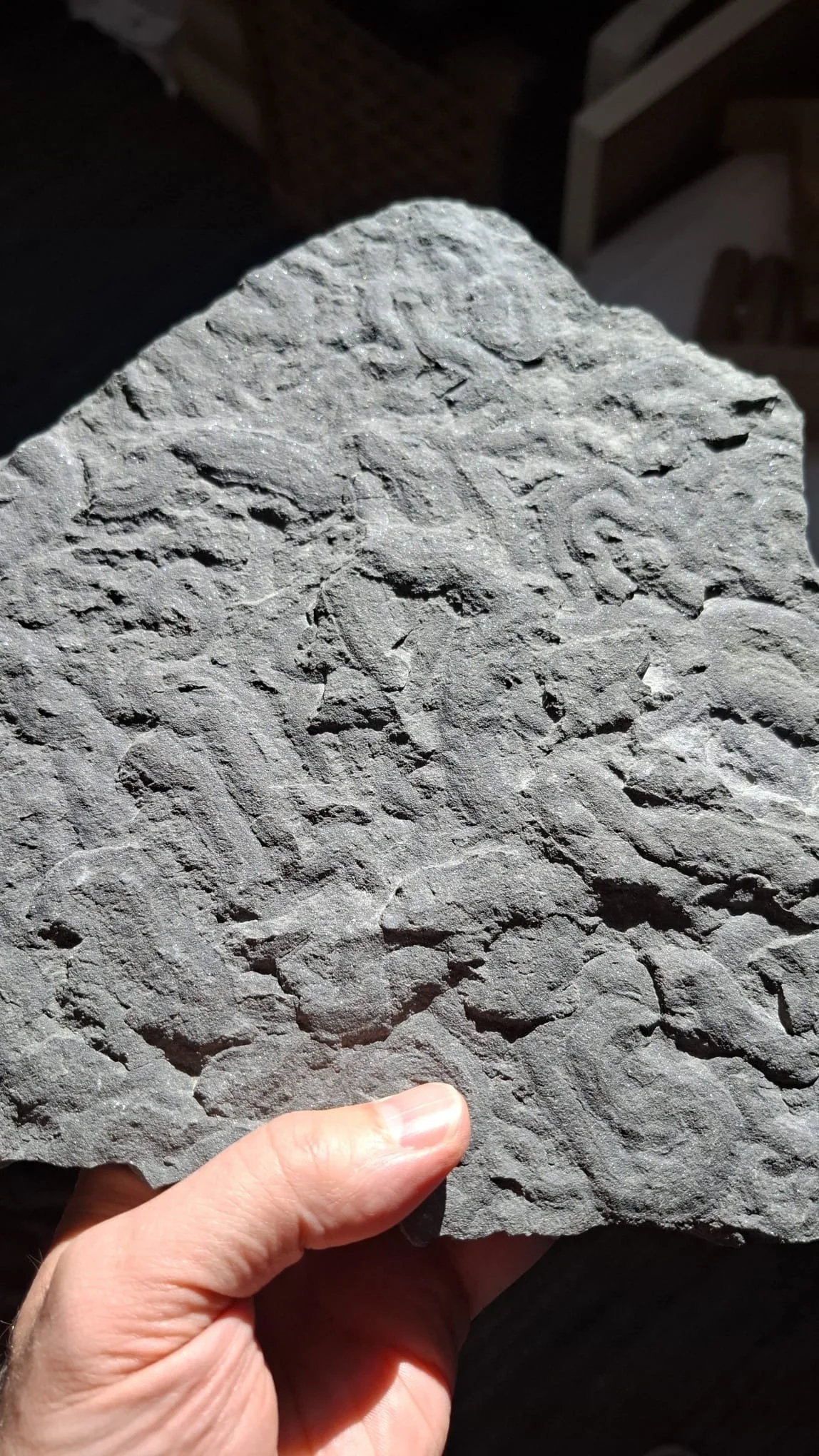
Our primary focus for the day was the Irish sandstone that will form the base of the garden’s water feature. This is not an off the shelf material. It has been specially sourced by Allgreen for our project, drawn from the cliffs of Maher in Ireland, and brought into the scheme with a sense of real exclusivity. There is something deeply satisfying about knowing that this stone has been selected with such specificity, not only for its performance, but for its story.
Seeing it again, now cut and prepared, was a moment of genuine excitement. The team at Allgreen have taken our drawings and translated them with absolute precision. Each piece has been cut to sit exactly as intended, forming a base that feels both engineered and entirely natural. That balance is not easily achieved.
Up close, the stone reveals its true richness. The riven surface is alive with detail. Fossilised traces of sand eels run through it, subtle but unmistakable once seen. Between them, the layering of sediment tells its own story, recording the retreat of ancient seas in bands of tone and texture. It is this depth that elevates the material beyond something purely functional. It becomes narrative. It becomes memory, held within the fabric of the garden.
Reworking Luciano Sandstone
Alongside this, we revisited the Luciano sandstone that will appear elsewhere in the scheme. Here, we have taken a deliberately different approach. Rather than commissioning freshly quarried stone, we have chosen to work with material that had previously been rejected by another client. It is easy, particularly at Chelsea, to default to perfection in the conventional sense. But there is a growing responsibility to think differently about how we source and use materials.
These stones, set aside and overlooked, offer an opportunity. By reworking them, cutting them down into bespoke planks, we are able to give them a new purpose within the garden. The result will not feel compromised. Quite the opposite. The slight irregularities and variations will bring a subtle individuality to each piece, reinforcing the crafted quality of the space.
Sustainability is often discussed in broad terms, but it is decisions like this that begin to give it real substance. It is about looking again at what already exists, and recognising its potential.
The Art of Selecting Boulders
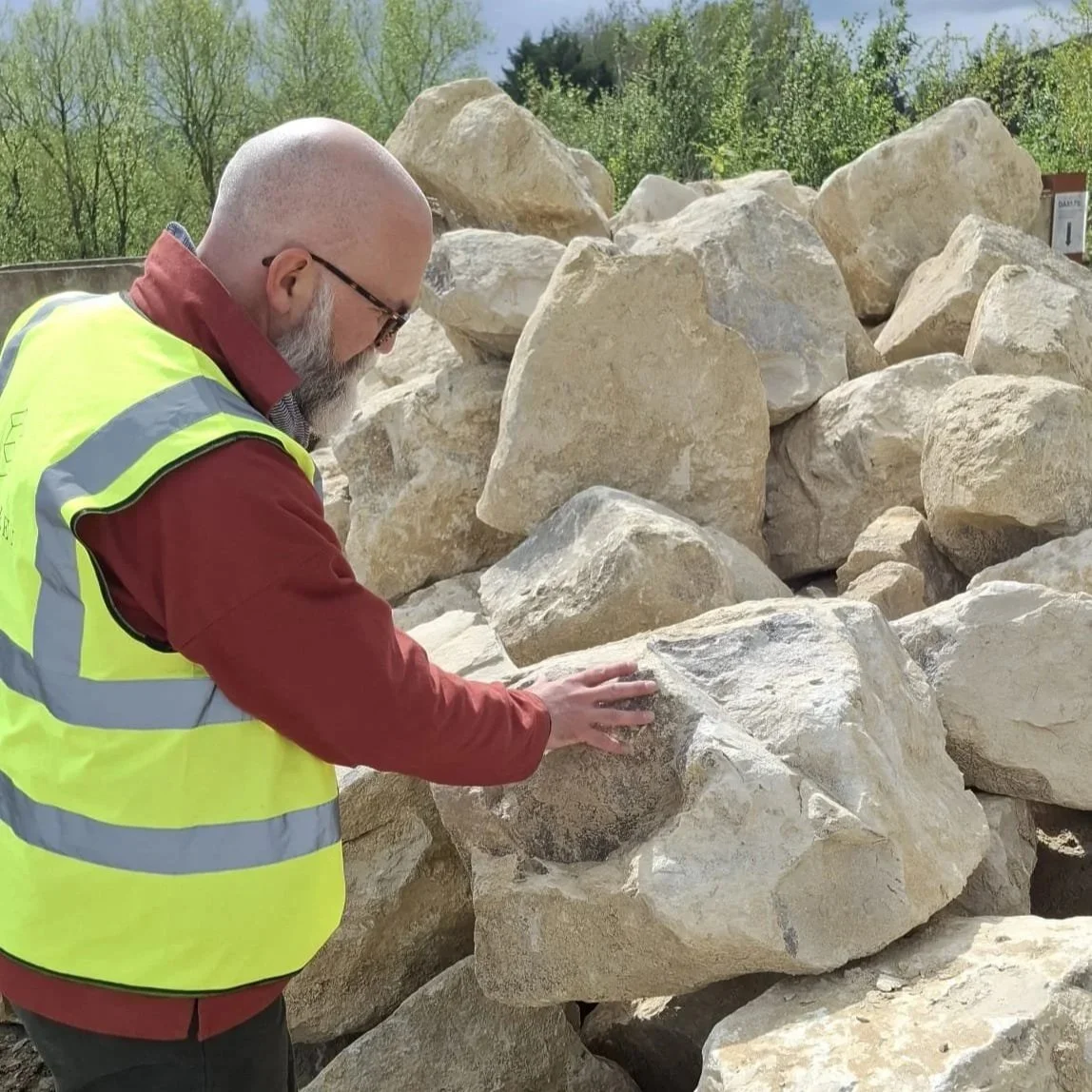
The afternoon was spent moving through the gravel yard and boulder fields, which is always one of the more tactile and instinctive parts of the process. While drawings and specifications guide much of what we do, selecting feature stones remains something that cannot be fully captured on paper. It requires time, patience, and a willingness to engage directly with the material.
Each boulder was approached individually. We walked around them, considered their proportions, their faces, the way they might sit within the landscape. Some were dismissed immediately. Others held our attention a little longer. The aim is never simply to choose something that looks impressive in isolation, but to find stones that will contribute meaningfully to the composition of the garden.
Scale plays a role, of course, but so too does character. A subtle ridge, a weathered edge, a variation in tone. These are the details that, once placed, will catch the light or draw the eye in a quiet, understated way. When positioned thoughtfully, they bring height and rhythm to the planting, anchoring the softer elements and giving structure to the space.
It is a process we undertake for all of our projects, not just Chelsea. Every client benefits from this level of attention. Whether the stones are destined for a show garden or a private landscape, the principle remains the same. Materials should be chosen with care, with intention, and with an understanding of how they will live within the garden over time.
Laying the Foundations
By the end of the day, there was a sense of clarity. The key materials had been confirmed, refined, and in some cases rediscovered. There is still much to be done, but these decisions form a foundation. They will influence everything that follows, from the planting to the final detailing on site.
Chelsea has a way of sharpening focus. It demands precision, but it also rewards thoughtfulness. Days like this, spent amongst stone and gravel, may not always be visible in the finished garden, but they are present in every surface, every junction, every carefully considered moment.
And when visitors eventually walk through the space, pausing perhaps by the water feature or noticing the placement of a single boulder, it is these quieter decisions that will shape their experience, even if they are never fully aware of them.